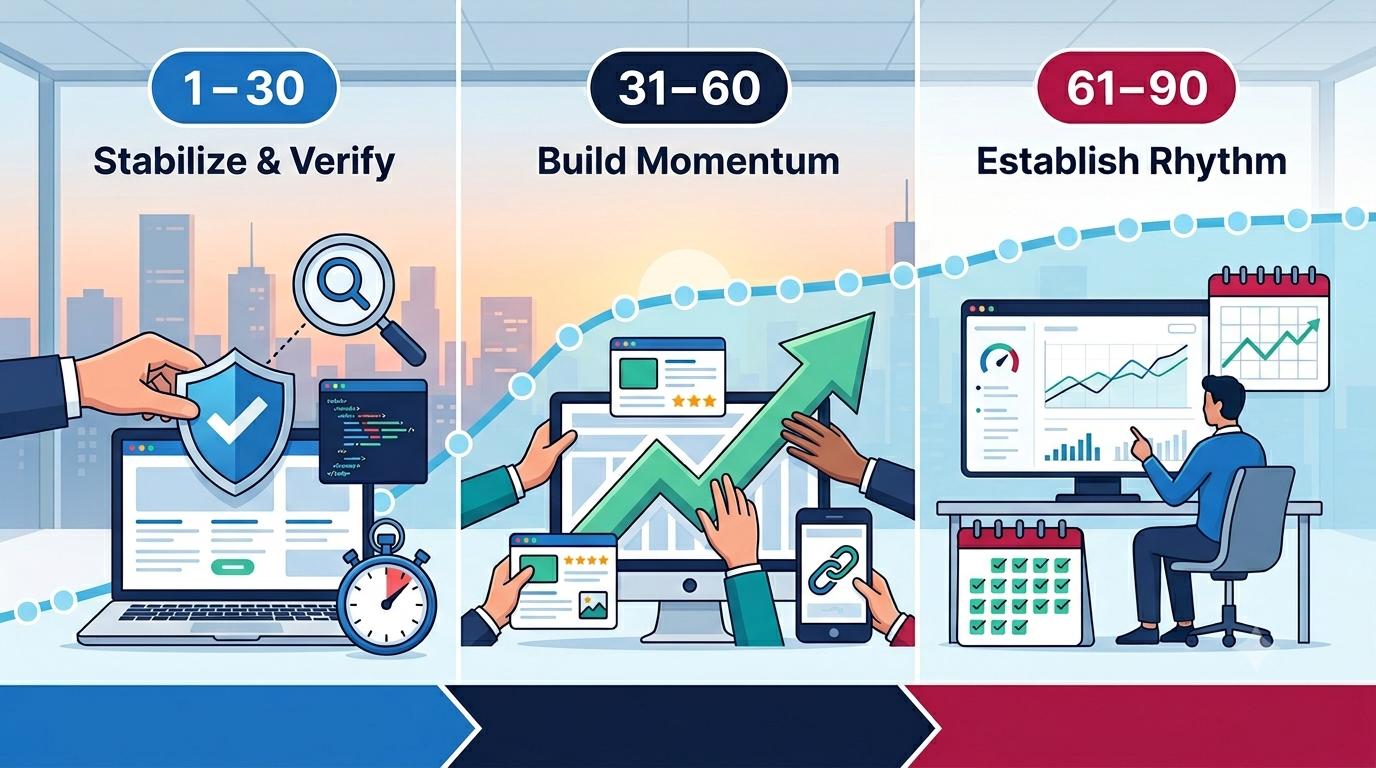
What happens after your website goes live? A practical 90-day plan covering Days 1-30 (stabilize), 31-60 (build momentum), and 61-90 (establish rhythm) — from Atomicslate Labs.
1Days 1–30: Stabilize and Verify
The instinct right after launch is to start promoting immediately. Resist that for the first couple of weeks — this phase is about confirming the foundation actually holds before you put traffic on top of it.
Confirm the technical basics are actually working
Test contact forms end to end — not just that they submit, but that the email arrives where it should. Check that analytics and conversion tracking are firing correctly; this is one of the most common gaps after a launch, and every day it's broken is data you can never get back. Screenshot your baseline numbers now — you'll need this reference point at 30, 60, and 90 days.
Check what search engines and AI crawlers can see
Make sure robots.txt isn't accidentally blocking pages it shouldn't, submit your sitemap in Google Search Console, and confirm your most important pages are indexable. If your previous site had real search visibility, make sure proper redirects are in place — a forgotten redirect is one of the most expensive small oversights to fix later.
Watch real behavior, not your assumptions
Use session recordings or a heatmap tool if you have one, and pay attention to where people actually click, scroll, and drop off. The patterns you expected and the patterns that actually happen are rarely identical — this is the cheapest window you'll get to catch a problem before it costs you traffic.
You should have a stable, verified baseline — not yet a growth story, just a trustworthy foundation to build on.
2Days 31–60: Build Momentum
With the foundation confirmed, this phase is where you start actively pushing the site to perform, rather than just making sure it can.
Start publishing on a consistent cadence
This is the period where fresh, well-structured content starts to matter — for traditional search and for AI assistants increasingly involved in how people research a purchase. Lead with a direct answer early in each piece, use clear headers, and structure comparisons as tables rather than paragraphs — the formats search engines and AI systems prefer to extract and cite.
Look at your early conversion data and act on it
By now you should have enough sessions to spot real patterns — where people drop off, which CTAs get ignored, which pages have unexpectedly high or low engagement. Don't redesign yet. Make targeted, specific fixes: clarify a headline, shorten a form, fix a CTA nobody's clicking. Small, evidence-based changes compound faster than a big swing based on a guess.
Start building external signals
Genuine mentions, reviews, directory listings, and backlinks from credible sources begin to matter here, both for traditional SEO authority and for how confidently AI tools cite your business when someone asks for a recommendation.
The site should be showing early, measurable signs of traction — not mature results yet, but a clear upward trend against your day-30 baseline.
3Days 61–90: Establish the Rhythm
The final phase isn't about a final push — it's about making sure the momentum from the previous 60 days doesn't quietly stall the moment attention moves elsewhere.
Compare your 90-day numbers against your original baseline
Traffic, conversion rate, lead quality — whatever you defined as success at the start. This is the point where you can honestly say whether the site is working, and where. Some of the most meaningful early gains tend to show up clearly by this point if the first two phases were done well.
Decide what becomes ongoing, not occasional
Content publishing, performance monitoring, and a regular technical audit shouldn't be a launch-quarter activity that quietly fades — they need an owner and a cadence past day 90, or the gains from the first two phases tend to erode within a few months.
Plan the next quarter based on evidence, not assumptions
By now you have real data about what's working and what isn't. Use it to decide what to invest more in, what to fix, and what to leave alone — rather than starting the next phase the same way most businesses start the first: by guessing.
The Part Most Businesses Skip
The single biggest predictor of whether a launch turns into sustained growth isn't the quality of the build — it's whether anyone treats the 90 days after launch as seriously as the weeks before it. A beautifully built site with no post-launch plan tends to plateau quietly, and most business owners don't notice until growth has already stalled for a while.
Almost all the planning energy goes into design and build. Almost none goes into the 90 days that actually determine whether the launch was worth it.
Atomicslate Labs Team
The Atomicslate Labs Team team brings you expert-reviewed guides and practical architecture advice for businesses scaling in the modern web era.